Feature Article
The Tax Risk Hiding in “Due From”
 How informal owner advances and related-party transfers become tax problems.
Most closely held business owners do not call their enrolled agent before moving money. They transfer funds between entities. They pay expenses from the wrong account. They advance cash to a family member working in the business. They move money from one commonly controlled company to another because payroll is due, a deal is closing, or one entity has cash, and another does not.
Months later, the accountant, bookkeeper, or tax professional opens the books and sees familiar labels: “Due from shareholder,” “Due from related party,” “Due to affiliate,” “Owner advance,” “Intercompany receivable,” or simply “loan.”
Those labels may organize the balance sheet. They do not answer the tax question. Was the transfer a loan? A contribution? A distribution? Compensation? Rent? A reimbursement? A management fee? A gift?
Once the Internal Revenue Service (IRS) asks, informal intent is not enough. The facts determine what happened, and the file must substantiate those facts.
Related-party transactions are not inherently improper. Closely held businesses often use multiple entities, family members, trusts, real estate companies, management companies, and service entities. But related-party transactions are inherently evidentiary: the closer the parties are, the stronger the file needs to be.
This article does not attempt to cover every related-party rule. It focuses on the recurring audit problem: money moved, the label is unclear, and the facts and file must support the classification, pricing, performance, and reporting.
Why “Due From” Becomes Dangerous
“Due from” is often where uncertainty goes to hide.
It may begin innocently. The owner pays a company expense personally. One entity covers another entity’s bill. A shareholder takes cash and plans to repay it. A related entity provides services but does not invoice until year-end.
The transfer gets parked in the books until someone decides what it is. That delay creates risk. A loan with no note, no interest, no maturity date, and no repayment history may not look like a loan. A management fee with no agreement, no invoice detail, and no proof of services may not look like an ordinary and necessary business expense. Rent paid to a family-owned entity without
lease support or market data may invite questions about reasonableness.
Unrelated parties create evidence because they do not fully trust each other. They sign agreements, charge interest, issue invoices, demand payment, and enforce deadlines.
Related parties often skip those steps because they do trust each other. That trust may be good for family harmony. It is not a substitute for tax documentation.
Classification Comes First
Before applying the applicable federal rate (AFR), fair market value, or arm’s-length concepts, the practitioner must answer one question: what is the transaction?
A transfer cannot be defended well until its substance is identified and it is classified correctly.
A loan needs facts showing bona fide debt, supported by debt documentation. A contribution needs ownership and basis support. A distribution needs shareholder or partner treatment. Compensation needs services and reasonableness. Rent needs a lease and market support. A service fee needs scope, invoices, and proof of performance. A reimbursement needs an expense trail.
The enrolled agent’s first job is to slow the issue down and force the classification question. What did the parties intend when the money moved? What documents existed then? How was the transaction recorded? Did both sides report it consistently? Did the parties behave afterward in a way that matches the label?
A balance sheet account titled “Due from Shareholder” is not enough. The facts and the file must show whether the amount is a receivable the company expects to collect, a distribution already
taken, compensation not yet reported, or something else.
The tax result follows the classification. The classification must follow the facts.
Related-Party Loans: Debt Comes First; Applicable Federal Rates May Follow
Related-party loans are one of the most common problem areas in closely held businesses. Owners lend money to companies. Companies lend money to affiliates. One entity pays another entity’s
expenses. A parent lends money to a child in the family business. A shareholder takes cash with the intent to “settle up later.”
These arrangements can be legitimate. They can also become disguised distributions, capital contributions, compensation, gifts, or nonbusiness transfers when the file does not support debt treatment.
Section 7872 addresses specified categories of below-market loans, including gift loans, compensation-related loans, and corporation-shareholder loans. The IRS publishes applicable federal rates
monthly for federal income tax purposes. For loans between commonly controlled businesses, §482 and its regulations may instead govern whether the interest is arm’s length.i
The first question is whether the transfer is bona fide debt. Only then should the practitioner determine which stated-interest or imputed-interest rules apply. An AFR may support compliance with a federal interest-rate rule for a loan within its scope, but it is not necessarily an arm’s-length market rate and does not prove the transfer was a loan.
As a best practice, a related-party loan file should include a signed promissory note, principal amount, origination date, stated interest rate, applicable rate support, maturity date, repayment
schedule, default provisions, collateral terms where appropriate, and approval by the relevant owners, members, managers, or board. No single item is a universal legal prerequisite; debt
characterization depends on all the facts and circumstances.
The file should also show performance. Were payments made? Was interest accrued? Did the lender report interest income? Did the borrower report interest expense only where otherwise deductible? Did both sides show the receivable and payable consistently?
Courts considering debt characterization have looked to factors such as written instruments, fixed maturity dates, repayment rights, interest payments, capitalization, intent, source of repayment,
and whether the parties behaved like debtor and creditor. No single factor controls.ii
A useful practical test is simple: if the borrower stopped paying, what would the lender do?
If the honest answer is “nothing,” the loan may not look like a loan.
Family Businesses: The Informality Problem
Family-owned businesses deserve special attention because the related-party problem is amplified by family dynamics.
In family businesses, everyone may know what they meant. The IRS audits what they did.
Parent-to-child loans, shareholder advances, loans between sibling-owned entities, rent paid to family-owned real estate companies, family member compensation, ownership transition
financing, and company-paid personal expenses later labeled as loans all create risk when informality replaces documentation.
Family members often avoid formal terms because formal terms feel unnecessary or uncomfortable. But family status should increase formality, not reduce it. Documentation that would ordinarily accompany a comparable arm’s-length transaction—a note, lease, invoice, appraisal, or repayment schedule—may be especially useful evidence between family members, even though no single document determines the tax treatment.
The same debt-characterization principles apply with more practical pressure inside family businesses. Family loans are easier to defend when the documents, rate, payment behavior, and tax reporting tell the same story.
Related-Party Fees, Rent, and Compensation: Fair Market Value Needs a Method
Loans are only one category of related-party risk. Closely held businesses also pay rent, service fees, management fees, consulting fees, royalties, reimbursements, and compensation to owners, family members, and related entities.
These payments raise different questions under different substantive rules, including whether the amount satisfies the standard applicable to the particular transaction.
Section 162 allows deductions for ordinary and necessary business expenses, including reasonable compensation for services actually rendered and certain rent or other payments for business property.iii Section 482 permits the IRS to allocate income and deductions between or among two or more organizations, trades, or businesses owned or controlled directly or indirectly by the same interests when necessary to prevent tax evasion or clearly reflect income.iv
For domestic closely held businesses, the enrolled agent may not call this “transfer pricing.” Section 482 is not a universal related-party reasonableness rule, and its application depends on the transaction and the parties. The practical questions remain: what standard applies, and how was the number determined under that standard?
A number is not a method. A round number booked at year-end is an audit invitation.
Fair market value support depends on the transaction. Rent may require lease comparables. Compensation may require role, responsibility, time, qualifications, and market pay data. Service fees may require a written scope of services, invoices, time records, cost support, and proof of performance. Asset transfers may require appraisal or valuation support.
The key is to create a witness for the number: a study, appraisal, benchmark, comparable, invoice trail, board memo, or documented methodology.
Without that witness, the taxpayer is left explaining a related-party number with memory and assertion.
The January Audit Folder
Section 6001 provides the recordkeeping foundation: taxpayers must keep records sufficient to establish the items shown on a return.v
As a recommended practice under that broader recordkeeping obligation, assemble a related-party audit folder every January for the prior tax year, before the return is finalized and long before an IRS letter arrives. The folder should do more than show that money moved; it should help substantiate what the transfer was and how it was reported.
January is the right time because the books are being reviewed, year-end balances are visible, AFR support can be saved, invoices and agreements can be gathered, and unresolved “due from” or
“due to” accounts can be classified before the tax return locks in the story.
This is not about correcting history after the fact. It is about organizing available support in advance. If the IRS later requests documents, the practitioner should not be starting from memory, old
emails, or reconstructed explanations. The review file should already show what happened, why it happened, how the amount was determined, and how the transaction was reported, subject to a
deliberate review of any actual request for production.
For recurring closely held business clients, this should become an annual January procedure, not an emergency audit project.
The January folder should not be a collection of practitioner worries or informal risk labels. It should be an organized review file containing documents, support, reconciliations, and workpapers that show what happened and how it was reported. Internal notes about weak facts, missing items, or next steps may be maintained separately for file organization. That separation itself does not make the notes privileged or exempt from production; privilege and disclosure must be evaluated under the applicable law and the facts.
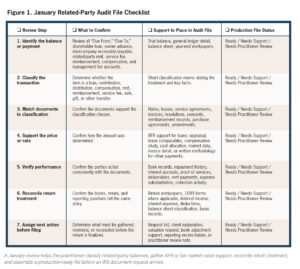
A January review helps the practitioner classify related-party balances, gather AFR or fair market value support, reconcile return treatment, and assemble a production-ready file before an IRS document request arrives.
Representation and Ethics
During representation, the enrolled agent should avoid two mistakes.
The first is overproducing documents without a theory. The second is telling a story that the records do not support.
A strong response starts with classification. Then it moves to authority, documents, pricing, performance, and reporting. Weak facts should be identified early. Late documentation, missing
payments, inconsistent reporting, and stale receivables do not always destroy a position, but they must be understood before the practitioner presents the taxpayer’s explanation.
Circular 230 requires practitioners to exercise due diligence in preparing or assisting with returns and other papers relating to IRS matters and in determining the correctness of representations made to Treasury and to clients.vi
That duty matters in related-party work.
A practitioner should not defend a transaction merely because paper exists. The transaction’s substance comes first; the documents are evidence to be tested against the economics, the books, the tax reporting, and the parties’ conduct.
The ethical question is not only, “Can the taxpayer produce a document?” The better question is, “Does the document tell the truth?”
Conclusion: The File Has to Tell the Story
Related-party transactions are normal in closely held business life. Owners move capital. Entities share expenses. Family members work in the company. Related entities rent property, provide services, and lend money.
But normal does not mean informal.
The strongest audit defense is built before the audit: when the money moves, when the transaction is classified, when the number is supported, and when the January folder is ready before anyone
asks for it.
i IRC §7872; IRC §1274(d). The IRS publishes applicable federal rates monthly by revenue ruling. See Internal Revenue Service, Applicable Federal Rates, https://www.irs.gov/applicablefederal-rates.
ii Estate of Mixon v. United States, 464 F.2d 394 (5th Cir. 1972).
iii IRC §162(a); Treas. Reg. §1.162-7(a).
iv IRC §482; Treas. Reg. §1.482-1(b)(1).
v IRC §6001; Treas. Reg. §1.6001-1(a).
vi 31 C.F.R. §10.22.
 Alexander Jones, EA, is cofounder and CEO of Guardian Tax Consultants, a national tax strategy firm he started in 2011 to bring advanced-planning architecture and reviewer-grade methodology to closely held and family-owned businesses. He has more than 20 years of experience in tax strategy, succession architecture, IRS representation, and advanced planning for privately held businesses. His practice focuses on helping owners and their advisory teams build audit-defensible documentation, substantiation, valuation support, and governance systems for related-party transactions and complex business arrangements. He is a member of the National Association of Enrolled Agents and speaks nationally on related-party documentation and advanced tax architecture for closely held businesses.
Related Content